Integration#
In calculus, you saw a definition of a definite integral that looked something like:
where the number of intervals you divide \([a, b]\) into, \(N\), is defined such that \(N = (b -a) / \Delta x\).
Also recall that this definition is directly related to the interpretation of an integral representing the area under a curve.
Rectangle rule#
The simplest way to compute the integral is to treat each interval as a rectangle:
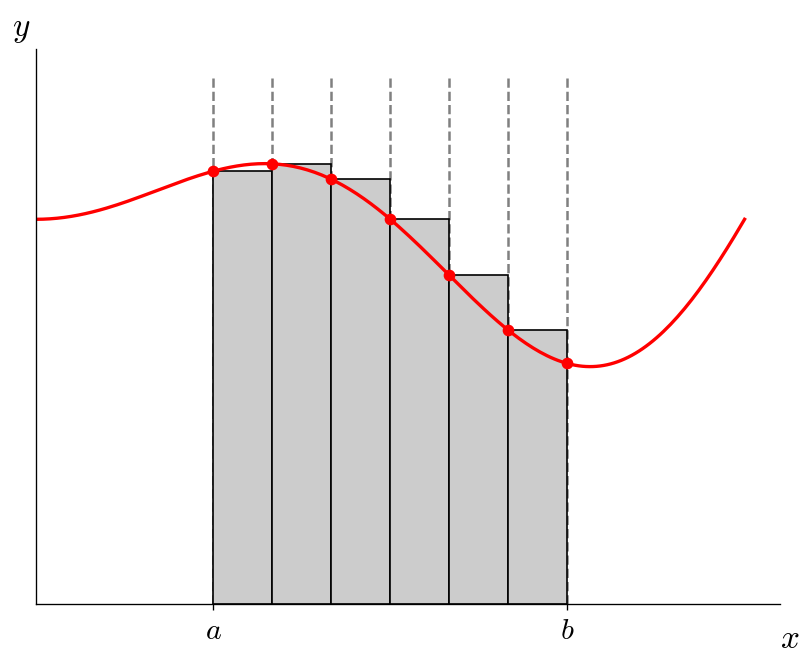
Fig. 6 The rectangle rule—we divide the area under the curve into intervals (\(N = 6\) shown here) and represent each as a rectangle.#
Adding up the area of each rectangle, we have an approximation to the integral:
This is not very accurate, and the truncation error can be shown to be \(\mathcal{O}(\Delta x)\)—making the method first-order accurate.
Trapezoid rule#
The trapezoid rule is an improvement on the rectangle rule. Now we use the function values on the left and right edges of each interval (\(f_l\) and \(f_r\) respectively) and connect them with a line. This makes the area in each interval a trapezoid, with an area of \(\frac{1}{2}\Delta x (f_l + f_r)\).
Visually this appears as:
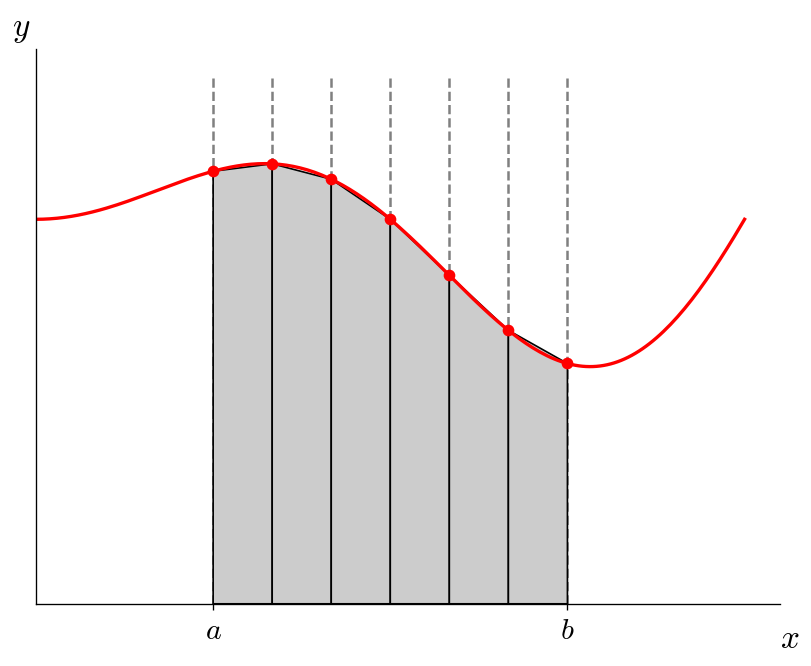
Fig. 7 The trapezoid rule—again using \(N = 6\), we connect the left and right function values for each interval, making trapezoids.#
Summing the areas over all the intervals, we get an approximation for the integral:
This is second-order accurate, and usually works quite well.
Example#
Let’s try out the trapezoid rule with the function:
on the interval \([1/2, 3/2]\).
The analytic result is
Here’s an implementation that tries several different values of \(N\):
#include <iostream>
#include <functional>
#include <numbers>
#include <cmath>
#include <format>


// the integrand / function we are integrating
double f(double x) {
    return 1.0 + 0.25 * x * std::sin(std::numbers::pi * x);
}


// the analytic integral of f(x) over our limits
double I_analytic() {
    return 1.0 - 1.0 / (2.0 * std::pow(std::numbers::pi, 2.0));
}


// trapezoid rule for numerical integration
double trapezoid(double a, double b, int N,
                 std::function<double(double)> func) {

    // compute the width of an interval
    double dx = (b - a) / static_cast<double>(N);

    double I{};

    // loop over intervals
    for (int n = 0; n < N; ++n) {
        double xl = a + dx * n;
        double xr = a + dx * (n+1);

        double fl = func(xl);
        double fr = func(xr);

        I += 0.5 * dx * (fl + fr);
    }

    return I;

}


int main() {

    // perform trapezoid integration on f(x) for a variety on N and
    // compute the error compared to the analytic solution

    double a = 0.5;
    double b = 1.5;

    std::cout << std::format("{:^3} {:^10} {:^12}\n",
                             "N", "I", "error");

    auto I_exact = I_analytic();

    for (auto N : {2, 4, 8, 16, 32, 64, 128}) {
        auto I = trapezoid(a, b, N, f);
        double err = std::abs(I - I_exact);

        std::cout << std::format("{:3} {:10.5f} {:12.5e}\n",
                                 N, I, err);
    }
}
Some notes:
We use
std::functionto have ourtrapezoidfunction take the function we are integrating:double trapezoid(double a, double b, int N, std::function<double(double)> func)
This makes our function reusable for any integrand we want. We saw this in Passing a Function to a Function.
We are using a ranged-for loop over an initialization list to quickly allow us to explore different numbers of intervals:
for (auto N : {2, 4, 8, 16, 32, 64, 128})
We saw this in our List initializer discussion.
In our heading that we output, via:
std::cout << std::format("{:^3} {:^10} {:^12}\n",
                         "N", "I", "error");
we are using the
^format alignment character to center the names over the width of the columns we output. This is described in the standard format specification on cppreference.com.
when run, we get:
 N      I         error
  2    0.93750  1.18394e-02
  4    0.94665  2.68650e-03
  8    0.94868  6.56092e-04
 16    0.94918  1.63075e-04
 32    0.94930  4.07097e-05
 64    0.94933  1.01738e-05
128    0.94934  2.54321e-06
Notice that we converge as second-order—as we double the number of intervals, the error goes down by \(4\times\).
try it…
Our code is a bit inefficient. We are computing the left and right function values each time in the loop. But the right function value for interval \(n\) becomes the left function value for interval \(n+1\). Let’s reuse these values in our loop, which will cut the number of function evaluations in half.