Derivatives and Truncation#
Difference approximation to first derivative#
Consider the Taylor expansion of \(f(x)\) about some point \(x_0\):
where \(\Delta x = x - x_0\)
We can solve for the derivative to find an approximation for the first derivative:
This shows that this approximation for the derivative is first-order accurate in \(\Delta x\)—that is the truncation error of the approximation.
Note
We use big-O notation here to indicate the truncation error. By writing \(\mathcal{O}(\Delta x)\), we are saying that there are terms of order \(\Delta x\) that we are neglecting. These indicates the leading term of the truncation error.
Note
This is called a finite-difference approximation to the derivative.
Roundoff vs. truncation#
We can see the relative size of roundoff and truncation error by using this approximation to compute a derivative for different values of \(\Delta x\):
#include <iostream>
#include <iomanip>
#include <cmath>
#include <limits>
#include <vector>
#include <format>

double f(double x) {
    return std::sin(x);
}

double dfdx_true(double x) {
    return std::cos(x);
}

struct point {
    double dx;
    double err;
};

int main() {

    double dx = 0.1;
    double x0 = 1.0;

    std::vector<point> data;

    while (dx > std::numeric_limits<double>::epsilon()) {

        point p;
        p.dx = dx;

        double dfdx_approx = (f(x0 + dx) - f(x0)) / dx;
        double err = std::abs(dfdx_approx - dfdx_true(x0));

        p.err = err;

        data.push_back(p);

        dx /= 2.0;
    }

    for (const auto p : data) {
        std::cout << std::format("{:12.6g} {:12.6g}\n", p.dx, p.err);
    }
}
Some notes about this code:
We use a
whileloop, and continue to loop so long asdxis larger than machine epsilon.We are storing the absolute value of the error—we don’t care about the sign here.
When we run this, we’ll see:
        0.1    0.0429386
       0.05    0.0212575
      0.025    0.0105741
     0.0125    0.0052732
    0.00625   0.00263311
   0.003125   0.00131568
  0.0015625  0.000657619
 0.00078125  0.000328755
0.000390625  0.000164364
0.000195313  8.21783e-05
9.76563e-05  4.10883e-05
4.88281e-05  2.05439e-05
2.44141e-05  1.02719e-05
 1.2207e-05  5.13594e-06
6.10352e-06  2.56797e-06
3.05176e-06    1.284e-06
1.52588e-06  6.41936e-07
7.62939e-07  3.20994e-07
 3.8147e-07  1.60632e-07
1.90735e-07   8.0596e-08
9.53674e-08  3.92685e-08
4.76837e-08  1.94779e-08
2.38419e-08   1.2493e-08
1.19209e-08  3.17978e-09
5.96046e-09  3.17978e-09
2.98023e-09  1.54467e-08
1.49012e-09  5.90591e-08
7.45058e-10  5.90591e-08
3.72529e-10  8.99525e-08
1.86265e-10  8.99525e-08
9.31323e-11  5.06094e-07
4.65661e-11  5.06094e-07
2.32831e-11  1.87809e-06
1.16415e-11  1.87809e-06
5.82077e-12  7.65865e-06
2.91038e-12  1.14148e-05
1.45519e-12  1.14148e-05
7.27596e-13  1.14148e-05
3.63798e-13  0.000141173
1.81899e-13  0.000141173
9.09495e-14  0.000469179
4.54747e-14   0.00168988
2.27374e-14   0.00319293
1.13687e-14   0.00319293
5.68434e-15   0.00657269
2.84217e-15   0.00657269
1.42109e-15    0.0715523
7.10543e-16    0.0715523
3.55271e-16    0.0846977
It is easier to see the behavior if we make a plot of the output:
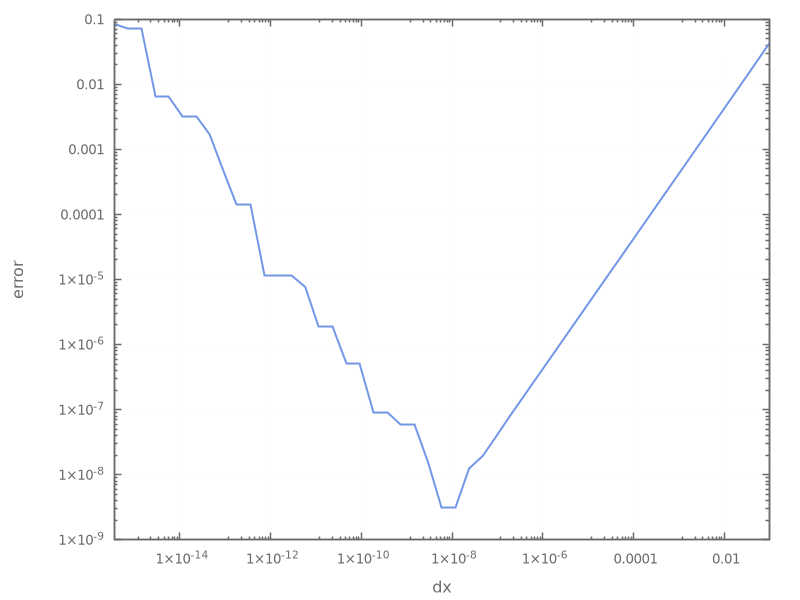
Let’s discuss the trends:
Starting with the largest value of \(\Delta x\), as we make \(\Delta x\) smaller, we see that the error decreases. This is following the expected behavior of the truncation error derived above.
Once our \(\Delta x\) becomes really small, roundoff error starts to dominate. In effect, we are seeing that:
\[(x_0 + \Delta x) - x_0 \ne 0\]because of roundoff error.
The minimum error here is around \(\sqrt{\epsilon}\), where \(\epsilon\) is machine epsilon.
Tip
For computing a finite-difference approximation to a derivative, \(\Delta x\) should be chosen such that \(|\Delta x / x_0| \sim \sqrt{\epsilon}\).