Datatype Sizes and Limits#
Sizes#
When we declare an object in C++, the compiler will reserve memory to hold the data. The amount of memory needed depends on the datatype.
Important
C++ guarantees a minimum size of the different types, but different compilers or processors may have different defaults.
We can explicitly determine this with a C++ program using
sizeof()—that returns the number of bytes
std::cout << sizeof(double) << std::endl;
The following is guaranteed:
sizeof(char) == 1 <= sizeof(short)
                  <= sizeof(int)
                  <= sizeof(long)
                  <= sizeof(long long)
Tip
If you want to guarantee a size for an int, there are datatypes that explicitly
require a fixed width, like int32_t: https://en.cppreference.com/w/cpp/types/integer
Reporting limits#
We can find out a lot about the range and precision of numbers that can be stored with a given type by using std::numeric_limits:
#include <iostream>
#include <limits>

int main() {

    std::cout << "double: " << std::endl;
    std::cout << "  smallest value = " << std::numeric_limits<double>::min() << std::endl;
    std::cout << "  lowest value = " << std::numeric_limits<double>::lowest() << std::endl;
    std::cout << "  largest value = " << std::numeric_limits<double>::max() << std::endl;

    std::cout << "int: " << std::endl;
    std::cout << "  smallest value = " << std::numeric_limits<int>::min() << std::endl;
    std::cout << "  lowest value = " << std::numeric_limits<int>::lowest() << std::endl;
    std::cout << "  largest value = " << std::numeric_limits<int>::max() << std::endl;

}
Note
We are again using the <> notation here to indicate the datatype
we are interested in. We first saw this with static_cast.
Overflow and underflow#
What happens if we exceed the limits of a data type?
For floating point, we don’t abruptly transition to 0. (for underflow)
but instead start losing digits of precision as subnormal numbers.
For integers, it is more fun:
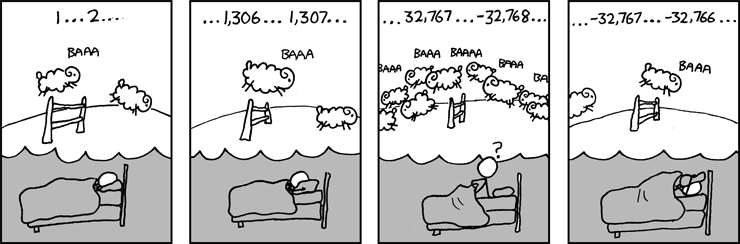
Try it…
Create a program that initializes a short integer and through
addition triggers an overflow.
Floating point precision#
Precision is also important with floating point. Consider the following: what do you expect?
double a = 1.0;
double b = -1.0;
double c = 2.e-15;

std::cout << (a + b) + c << std::endl;
std::cout << a + (b + c) << std::endl;
With floating point, the associate property of addition does not hold.