O-burning#
Oxygen burning primarily takes place via:
import pynucastro as pyna
Note
There are several libraries that provide compilations of reaction rates. Two popular ones are ReacLib and StarLib. Both provide ~ 80k rates for a variety of nuclear processes.
MESA uses ReacLib for rates, so that will be our source for the O-burning rates.
rl = pyna.ReacLibLibrary()
rates = rl.get_rate_by_name(["o16(o16,a)si28",
                             "o16(o16,p)p31",
                             "o16(o16,n)s31"])
import numpy as np
import matplotlib.pyplot as plt
fig, ax = plt.subplots()
Ts = np.logspace(9, 9.5, 100)

for r in rates:
    ax.loglog(Ts, [r.eval(T) for T in Ts], label=f"{r.pretty_string}")

ax.grid(ls=":")
ax.legend()
<matplotlib.legend.Legend at 0x7ff89811da90>
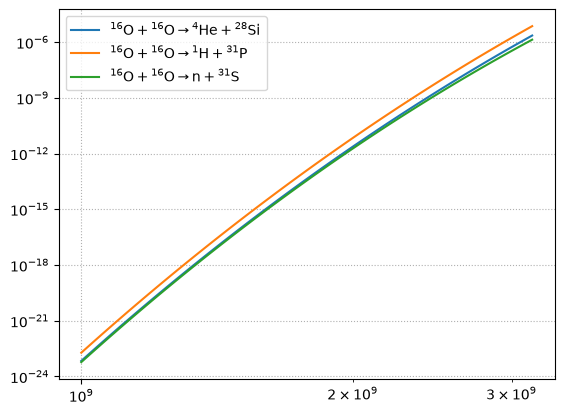
Notice that the branching that emits a neutron is the slowest. It is also the least energetic
for r in rates:
    print(f"{r!s:30} : {r.Q} MeV")
O16 + O16 ⟶ He4 + Si28         : 9.593 MeV
O16 + O16 ⟶ p + P31            : 7.678 MeV
O16 + O16 ⟶ n + S31            : 1.5 MeV
for this reason, it is often neglected.
We can also check the temperature sensitivity, by expressing the rate as:
exploring various \(T_0\), we find:
for T0 in [5.e8, 1.e9, 2.e9, 4.e9]:
    nu = rates[0].get_rate_exponent(T0)
    print(f"{T0:6.2g} : {nu:5.2f}")
 5e+08 : 55.96
 1e+09 : 43.64
 2e+09 : 33.24
 4e+09 : 23.75
This is extremely temperature sensitive.
Approximate O burning#
We can approximate O-burning by assuming that the \({}^{31}\mathrm{P}\) nucleus is in equilibrium.
net = pyna.network_helper(["p", "he4", "o16", "si28", "p31", "s32"])
fig = net.plot(rotated=True, size=(1000, 400))
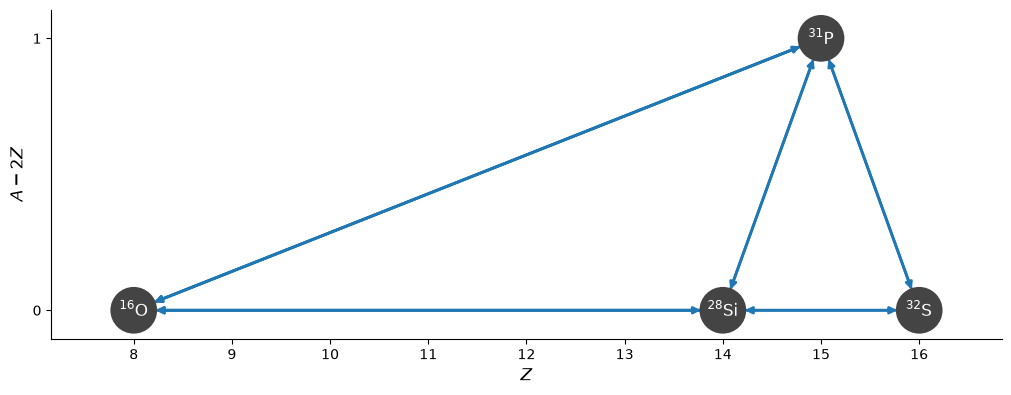
The idea is to take \(dY({}^{31}\mathrm{P})/dt = 0\)
dydt = net.full_ydot_string(pyna.Nucleus("p31"))
print(dydt)
dYdt[jp31] = (
      ( -rho*Y[jp]*Y[jp31]*rate_eval.P31_p_to_S32_reaclib +Y[js32]*rate_eval.S32_to_p_P31_derived ) +
      ( +5.00000000000000e-01*rho*Y[jo16]**2*rate_eval.O16_O16_to_p_P31_reaclib -rho*Y[jp]*Y[jp31]*rate_eval.P31_p_to_O16_O16_derived ) +
      ( -rho*Y[jp]*Y[jp31]*rate_eval.P31_p_to_He4_Si28_reaclib +rho*Y[jhe4]*Y[jsi28]*rate_eval.Si28_He4_to_p_P31_derived )
   )
we can solve for the equilibrium abundance of \(Y({}^{31}\mathrm{P})\) and approximate it out.
net.make_CO_burning_approx("O")
net.remove_nuclei(["p31"])
fig = net.plot(rotated=True, size=(1000, 400))
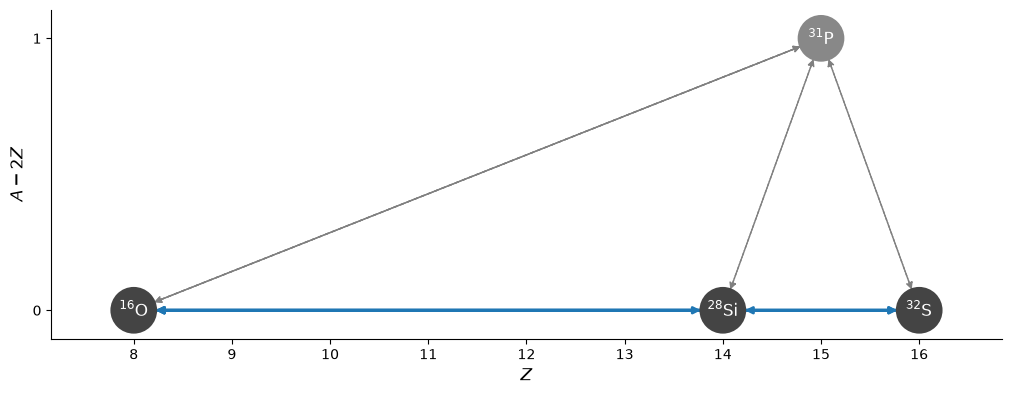
We’ll use the approximate rate for \({}^{16}\mathrm{O}({}^{16}\mathrm{O},\alpha){}^{28}\mathrm{Si}\)
r1616 = net.get_rate_by_name("o16(o16,a)si28")
print(r1616.function_string_py())
@numba.njit()
def O16_O16_to_Si28_He4_approx(rate_eval, tf):
    r_pY = rate_eval.P31_p_to_O16_O16_derived
    r_pa = rate_eval.P31_p_to_He4_Si28_reaclib
    r_pg = rate_eval.P31_p_to_S32_reaclib
    denom = r_pY + r_pa + r_pg
    r_Ya = rate_eval.O16_O16_to_He4_Si28_reaclib
    r_Yp = rate_eval.O16_O16_to_p_P31_reaclib
    rate = r_Ya + r_Yp * r_pa / denom
    rate_eval.O16_O16_to_Si28_He4_approx = rate
This combines \({}^{16}\mathrm{O}({}^{16}\mathrm{O},\alpha){}^{28}\mathrm{Si}\) + \({}^{16}\mathrm{O}({}^{16}\mathrm{O},p){}^{31}\mathrm{P}(p,\alpha){}^{28}\mathrm{Si}\)
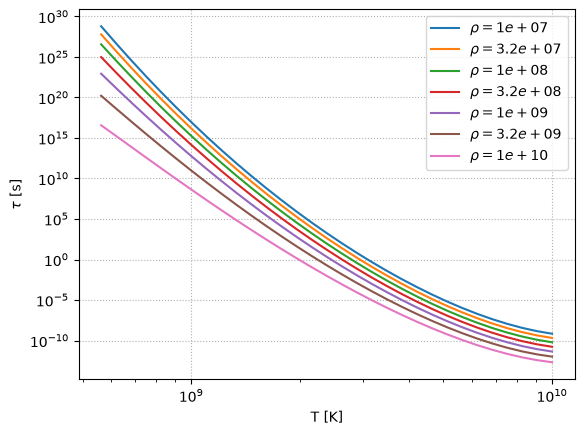
Timescales#
We can compute the timescale for burning as
net = pyna.PythonNetwork(rates=[r1616])
rhos = np.logspace(7, 10, 7)
Ts = np.logspace(8.75, 10, 31)

comp = pyna.Composition(net.unique_nuclei)
comp.X[pyna.Nucleus("o16")] = 0.5
comp.X[pyna.Nucleus("ne20")] = 0.5
o16 = pyna.Nucleus("o16")
fig, ax = plt.subplots()

for rho in rhos:
    xdots = np.array([net.evaluate_ydots(rho, T, comp,
                                         screen_func=pyna.screening.screen.chugunov_2007)[o16] * o16.A
                      for T in Ts])
    ax.loglog(Ts, 1.0 / np.abs(xdots), label=rf"$\rho = {rho:6.2g}$")
ax.grid(ls=":")
ax.set_xlabel("T [K]")
ax.set_ylabel(r"$\tau$ [s]")
ax.legend()
/tmp/ipykernel_2858/4259348270.py:4: DeprecationWarning: evaluate_ydots(rho, T, comp, ...) is deprecated, use evaluate_ydots(ThermoState(rho=rho, T=T, comp=comp,  ...) instead
  xdots = np.array([net.evaluate_ydots(rho, T, comp,
/tmp/ipykernel_2858/4259348270.py:4: DeprecationWarning: evaluate_ydots(rho, T, comp, ...) is deprecated, use evaluate_ydots(ThermoState(rho=rho, T=T, comp=comp,  ...) instead
  xdots = np.array([net.evaluate_ydots(rho, T, comp,
<matplotlib.legend.Legend at 0x7ff89735e270>